Climate Change Is Harming the Planet Faster Than
We Can Adapt, U.N. Warns
Countries aren’t doing nearly enough to protect against the disasters to come as the planet keeps heating up, a major new scientific report concludes.
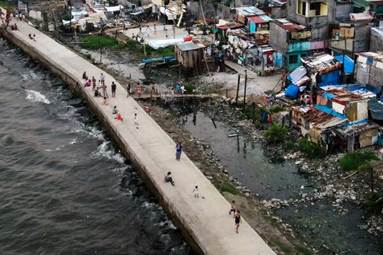
A seawall construction in low-lying metropolitan Manila, Philippines. Many developing countries lack the resources to prepare for the more serious climate-related threats still to come.Credit...Chang W. Lee/The New York Times
By Brad Plumer and Raymond Zhong Feb. 28, 2022Updated 10:15 a.m. ET New York Times
The dangers of climate change are mounting so rapidly that they could soon overwhelm the ability of both nature and humanity to adapt unless greenhouse gas emissions are quickly reduced, according to a major new scientific report released on Monday.
The report by the Intergovernmental Panel on Climate Change, a body of experts convened by the United Nations, is the most detailed look yet at the threats posed by global warming. It concludes that nations aren’t doing nearly enough to protect cities, farms and coastlines from the hazards that climate change has unleashed so far, such as record droughts and rising seas, let alone from the even greater disasters in store as the planet continues to warm.
Written by 270 researchers from 67 countries, the report is “an atlas of human suffering and a damning indictment of failed climate leadership,” said António Guterres, the United Nations secretary general. “With fact upon fact, this report reveals how people and the planet are getting clobbered by climate change.”
The perils are already visible across the globe, the report said. In 2019, storms, floods and other extreme weather events displaced more than 13 million people across Asia and Africa. Rising heat and drought are killing crops and trees, putting millions worldwide at increased risk of hunger and malnutrition, while mosquitoes carrying diseases like malaria and dengue are spreading into new areas. Roughly half the world’s population currently faces severe water scarcity at least part of the year.
Few nations are escaping unscathed. Blistering heat waves made worse by global warming have killed hundreds of people in the United States and Canada, ferocious floods have devastated Germany and China, and wildfires have raged out of control in Australia and Siberia.
“One of the most striking conclusions in our report is that we’re seeing adverse impacts that are much more widespread and much more negative than expected,” said Camille Parmesan, an ecologist at the University of Texas, Austin, and one of the researchers who prepared the report.
To date, many nations have been able to partly limit the damage by spending billions of dollars each year on adaptation measures like flood barriers, air-conditioning or early-warning systems for tropical cyclones.
But those efforts are too often “incremental,” the report said. Preparing for future threats, like dwindling freshwater supplies or irreversible ecosystem damage, will require “transformational” changes that involve rethinking how people build homes, grow food, produce energy and protect nature.
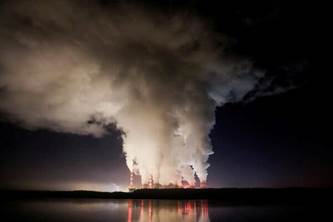
Smoke and steam billowing from Belchatow Power Station in Poland, Europe's largest coal-fired power plant. Credit...Kacper Pempel/Reuters
The report also carries a stark warning: If temperatures keep rising, many parts of the world could soon face limits in how much they can adapt to a changing environment. If nations don’t act quickly to slash fossil fuel emissions and halt global warming, more and more people will suffer unavoidable loss or be forced to flee their homes, creating dislocation on a global scale.
“There has been the assumption that, ‘Well, if we cannot control climate change, we’ll just let it go and adapt to it,’” said Hans-Otto Pörtner, a marine biologist in Germany who helped coordinate the report. But given the expected risks as the planet keeps warming, he said, “this is certainly a very illusionary approach.”
Global temperatures have already increased by an average of 1.1 degrees Celsius, or 2 degrees Fahrenheit, since the 19th century, as humans have pumped heat-trapping gases into the atmosphere by burning coal, oil and gas for energy, and cutting down forests.
Many leaders, including President Biden, have vowed to limit total global warming to no more than 1.5 degrees Celsius compared with preindustrial levels. That’s the threshold beyond which scientists say the likelihood of catastrophic climate impacts increases significantly.
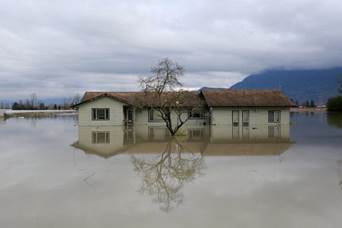
A home surrounded by floodwaters after rainstorms caused flooding and landslides in Chilliwack, British Columbia, in November 2021.Credit...Jesse Winter/Reuters
But achieving that goal would require nations to all but eliminate their fossil-fuel emissions by 2050, and most are far off-track. The world is currently on pace to warm somewhere between 2 degrees and 3 degrees Celsius this century, experts have estimated.
“Unchecked carbon pollution is forcing the world’s most vulnerable on a frog march to destruction — now,” Mr. Guterres said. “This abdication of leadership is criminal.”
If average warming passes 1.5 degrees Celsius, even humanity’s best efforts to adapt could falter, the report warns. The cost of defending coastal communities against rising seas could exceed what many nations can afford. In some regions, including parts of North America, livestock and outdoor workers could face rising levels of heat stress that make farming increasingly difficult, said Rachel Bezner Kerr, an agricultural expert at Cornell University who contributed to the report.
“Beyond 1.5, we’re not going to manage on a lot of fronts,” said Maarten van Aalst, the director of the Red Cross Red Crescent Climate Center and another author of the report. “If we don’t implement changes now in terms of how we deal with physical infrastructure, but also how we organize our societies, it’s going to be bad.”
Poor nations are far more exposed to climate risks than rich countries. Between 2010 and 2020, droughts, floods and storms killed 15 times as many people in highly vulnerable countries, including those in Africa and Asia, as in the wealthiest countries, the report said.
That disparity has fueled a contentious debate: what the industrialized nations most responsible for greenhouse gas emissions owe developing countries. Low-income nations want financial help, both to defend against future threats and to compensate for damages they can’t avoid. The issue will be a focus when governments meet for the next United Nations climate summit in Egypt in November.
“Climate change is the ultimate injustice,” said Ani Dasgupta, the president of the World Resources Institute, an environmental group. “People with the fewest resources, those least responsible for the climate crisis, bear the brunt of climate impacts.” He added, “If you don’t live in a hot spot, imagine instead a roof blown away, a village well overwhelmed by salt water, a failed crop, a job lost, a meal skipped — all at once, again and again.”
The report, which was approved by 195 governments, makes clear that risks to humans and nature accelerate with every additional fraction of a degree of warming.
At current levels of warming, for example, humanity’s ability to feed itself is already coming under strain. While the world is still producing more food each year, thanks to improvements in farming and crop technology, climate change has begun slowing the rate of growth, the report said, an ominous trend that puts future food supplies at risk as the world’s population soars past 8 billion people.
If global warming reaches 1.5 degrees Celsius — as is now likely within the next few decades — roughly 8 percent of the world’s farmland could become unsuitable for growing food, the authors wrote. Coral reefs, which buffer coastlines against storms and sustain fisheries for millions of people, will face more frequent bleaching from ocean heat waves and decline by 70 to 90 percent. The number of people around the world exposed to severe coastal flooding could increase by more than one-fifth without new protections.
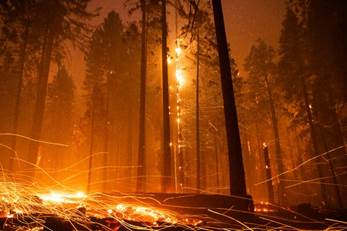
Embers flew as the Caldor fire burned in the Eldorado National Forest near Pollock Pines, Calif., in 2021. Credit...Max Whittaker for The New York Times
Image
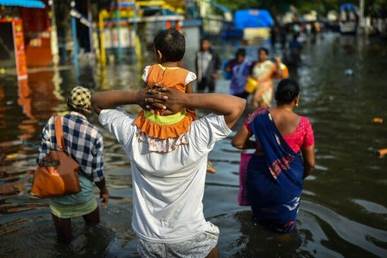
A father holding his child waded through a flooded neighborhood following heavy rains, in Chennai, India last year. Credit..Idrees Mohammed/EPA, via Shutterstock
At 2 degrees Celsius of warming, between 800 million and 3 billion people globally could face chronic water scarcity because of drought, including more than one-third of the population in southern Europe. Crop yields and fish harvests in many places could start declining. An additional 1.4 million children in Africa could face severe malnutrition, stunting their growth.
At 3 degrees of warming, the risk of extreme weather events could increase fivefold by century’s end. Flooding from sea-level rise and heavier rainstorms could cause four times as much economic damage worldwide as they do today. As many as 29 percent of known plant and animal species on land could face a high risk of extinction.
The report lays out strategies that nations can pursue to protect themselves, such as elevating homes above rising floodwaters or developing new crop varieties that can better tolerate heat and drought.
Humanity has already managed to reduce some of the harms from climate dangers. Over the past half-century, the number of deaths worldwide from storms, floods and other extreme weather events has fallen by more than half because of improved early warning systems and disaster management, the World Meteorological Organization has found. Investments in public health have meant fewer people are succumbing to diseases like cholera, even as rising temperatures and heavier rainfall have facilitated their spread.
But if global temperatures keep rising, adapting to climate change will become increasingly difficult, especially for poorer countries, the report said.
“If we are able to limit warming to 1.5 degrees, then the likelihood of large areas or specific islands becoming uninhabitable will be relatively low,” although they will remain vulnerable to storms and sea-level rise, said Adelle Thomas, an adaptation researcher at the University of the Bahamas and a report author. But higher levels of warming “could lead to those areas becoming uninhabitable,” she said.
A decade ago, wealthy nations pledged to deliver $100 billion per year to the developing world by 2020 to shift to cleaner sources of energy and adapt to climate change. But they have fallen short by tens of billions of dollars, with only a fraction of the funds spent on adaptation.
Meanwhile, many communities are acting in ways that increase their vulnerability, the report said. One reason flood risk is growing along the coasts, for instance, is that millions of people are moving to low-lying areas that are endangered by sea level rise. And some adaptation measures have unintended consequences. For instance, sea walls protect certain places but can also redirect flooding into populated areas elsewhere. Irrigation can help protect crops against drought but can also deplete groundwater resources.
“Despite the fact that we have been talking about climate change for a long period of time,” many regions are still developing in ways that make their people and ecosystems more exposed to the hazards, not less, said Ibidun O. Adelekan, a professor of geography at the University of Ibadan in Nigeria who worked on the report.
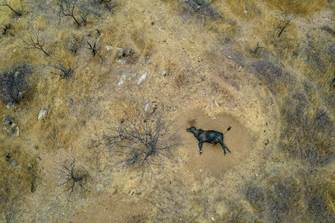
An ox carcass from a drone image in the Seridó region of Brazil, which is heavily impacted by drought and desertification. Brazil has the largest number of people living in areas that are becoming deserts.Credit...Victor Moriyama for The New York Times
Instead, the report recommends that leaders pursue more farsighted strategies. As oceans rise, coastal communities could relocate inland while additional development along vulnerable shorelines could be discouraged. Improvements in basic services like health, roads, electricity and water could help make poor and rural communities more resilient against climate shocks.
“The choice is not between if we transform or not anymore,” said Edward R. Carr, a professor of international development at Clark University and an author of the report. “The choice is, do we choose transformations we like? Or do we get transformed by the world in which we live because of what we’ve done to it?”
The report is part of the sixth major assessment of climate science from the Intergovernmental Panel on Climate Change, which was created in 1988. The first report in the series, released last August, examined the science behind how human activity is heating the planet. A separate report, expected this spring, will explore strategies to reduce greenhouse gas emissions and halt warming.
-----------------------------------------------------------------------------------------------------------------
· Understand the Latest News on Climate Change
· Struggling to adapt. The dangers of climate change are mounting so rapidly that they could soon overwhelm the ability of both nature and humanity to adapt unless greenhouse gas emissions are quickly reduced, according to a major U.N. report. Here are five takeaways from the report.
· The biggest climate case in a decade. The U.S. Supreme Court will hear arguments in a dispute that could restrict or even eliminate the E.P.A.’s authority to control the pollution that is heating the planet. A decision by the court, with its conservative supermajority, could shred President Biden’s climate agenda.
· A world on fire. A United Nations report has concluded that the risk of devastating wildfires around the world could increase by up to 57 percent by the end of the century, as climate change further intensifies what the authors of the document described as a “global wildfire crisis.”
· Melting away. Sea ice around Antarctica has reached a record low in four decades of observations, a new analysis of satellite images shows. While warmer ocean temperatures may have played a role, the precise effect of climate change on Antarctic sea ice remains unclear.
· A megadrought and rising sea levels. An intense drought in the American Southwest has become so severe that it’s now the driest 22-year period in the region in 1,200 years. Scientists are also warning that coastal sea levels in the U.S. will rise by about a foot or more on average by 2050.
----------------------------------------------------------------------------------------------------------------------------
Some earlier articles pertaining to reports by the Intergovernmental Panel on Climate Change published in the New York Times
A Hotter Future Is Certain, Climate Panel Warns. But How Hot Is Up to Us. Aug. 9, 2021
The World’s Oceans Are in Danger, Major Climate Change Report Warns Sept. 25, 2019
Major Climate Report Describes a Strong Risk of Crisis as Early as 2040 Oct. 7, 2018
Brad Plumer is a climate reporter specializing in policy and technology efforts to cut carbon dioxide emissions. At The Times, he has also covered international climate talks and the changing energy landscape in the United States. @bradplumer
Raymond Zhong is a climate reporter. He joined The Times in 2017 and was part of the team that won the 2021 Pulitzer Prize in Public Service for coverage of the coronavirus pandemic. @zhonggg
Major Climate Report Describes a Strong Risk of Crisis as Early as 2040
By Coral Davenport Oct. 7, 2018
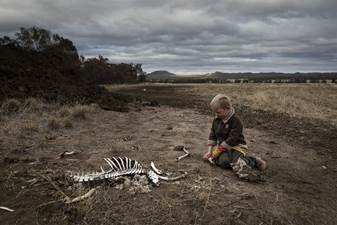
Harry Taylor, 6, played with the bones of dead livestock in Australia, which has faced severe drought.Credit...Brook Mitchell/Getty Images
INCHEON, South Korea — A landmark report from the United Nations’ scientific panel on climate change paints a far more dire picture of the immediate consequences of climate change than previously thought and says that avoiding the damage requires transforming the world economy at a speed and scale that has “no documented historic precedent.”
The report, issued on Monday by the Intergovernmental Panel on Climate Change, a group of scientists convened by the United Nations to guide world leaders, describes a world of worsening food shortages and wildfires, and a mass die-off of coral reefs as soon as 2040 — a period well within the lifetime of much of the global population.
The report “is quite a shock, and quite concerning,” said Bill Hare, an author of previous I.P.C.C. reports and a physicist with Climate Analytics, a nonprofit organization. “We were not aware of this just a few years ago.” The report was the first to be commissioned by world leaders under the Paris agreement, the 2015 pact by nations to fight global warming.
The authors found that if greenhouse gas emissions continue at the current rate, the atmosphere will warm up by as much as 2.7 degrees Fahrenheit (1.5 degrees Celsius) above preindustrial levels by 2040, inundating coastlines and intensifying droughts and poverty. Previous work had focused on estimating the damage if average temperatures were to rise by a larger number, 3.6 degrees Fahrenheit (2 degrees Celsius), because that was the threshold scientists previously considered for the most severe effects of climate change.
The new report, however, shows that many of those effects will come much sooner, at the 2.7-degree mark.

Why Half a Degree of Global Warming Is a Big Deal
Avoiding the most serious damage requires transforming the world economy within just a few years, said the authors, who estimate that the damage would come at a cost of $54 trillion. But while they conclude that it is technically possible to achieve the rapid changes required to avoid 2.7 degrees of warming, they concede that it may be politically unlikely.
For instance, the report says that heavy taxes or prices on carbon dioxide emissions — perhaps as high as $27,000 per ton by 2100 — would be required. But such a move would be almost politically impossible in the United States, the world’s largest economy and second-largest greenhouse gas emitter behind China. Lawmakers around the world, including in China, the European Union and California, have enacted carbon pricing programs.
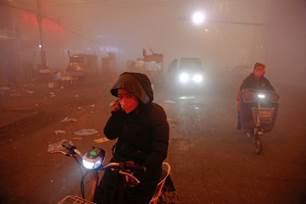
People on a smog-clouded street in Hebei Province, China, in 2016. China is the largest emitter of greenhouse gases, followed by the United States.Credit...Damir Sagolj/Reuters
President Trump, who has mocked the science of human-caused climate change, has vowed to increase the burning of coal and said he intends to withdraw from the Paris agreement. And on Sunday in Brazil, the world’s seventh-largest emitter of greenhouse gas, voters appeared on track to elect a new president, Jair Bolsonaro, who has said he also plans to withdraw from the accord.
The report was written and edited by 91 scientists from 40 countries who analyzed more than 6,000 scientific studies. The Paris agreement set out to prevent warming of more than 3.6 degrees above preindustrial levels — long considered a threshold for the most severe social and economic damage from climate change. But the heads of small island nations, fearful of rising sea levels, had also asked scientists to examine the effects of 2.7 degrees of warming.
Absent aggressive action, many effects once expected only several decades in the future will arrive by 2040, and at the lower temperature, the report shows. “It’s telling us we need to reverse emissions trends and turn the world economy on a dime,” said Myles Allen, an Oxford University climate scientist and an author of the report.
To prevent 2.7 degrees of warming, the report said, greenhouse pollution must be reduced by 45 percent from 2010 levels by 2030, and 100 percent by 2050. It also found that, by 2050, use of coal as an electricity source would have to drop from nearly 40 percent today to between 1 and 7 percent. Renewable energy such as wind and solar, which make up about 20 percent of the electricity mix today, would have to increase to as much as 67 percent.
“This report makes it clear: There is no way to mitigate climate change without getting rid of coal,” said Drew Shindell, a climate scientist at Duke University and an author of the report.

President Trump has vowed to increase the burning of coal and said he intends to withdraw from the Paris agreement.Credit...Doug Mills/The New York Times
The World Coal Association disputed the conclusion that stopping global warming calls for an end of coal use. In a statement, Katie Warrick, its interim chief executive, noted that forecasts from the International Energy Agency, a global analysis organization, “continue to see a role for coal for the foreseeable future.”
Ms. Warrick said her organization intends to campaign for governments to invest in carbon capture technology. Such technology, which is currently too expensive for commercial use, could allow coal to continue to be widely used.
Despite the controversial policy implications, the United States delegation joined more than 180 countries on Saturday in accepting the report’s summary for policymakers, while walking a delicate diplomatic line. A State Department statement said that “acceptance of this report by the panel does not imply endorsement by the United States of the specific findings or underlying contents of the report.”
The State Department delegation faced a conundrum. Refusing to approve the document would place the United States at odds with many nations and show it rejecting established academic science on the world stage. However, the delegation also represents a president who has rejected climate science and climate policy.
“We reiterate that the United States intends to withdraw from the Paris agreement at the earliest opportunity absent the identification of terms that are better for the American people,” the statement said.
The report attempts to put a price tag on the effects of climate change. The estimated $54 trillion in damage from 2.7 degrees of warming would grow to $69 trillion if the world continues to warm by 3.6 degrees and beyond, the report found, although it does not specify the length of time represented by those costs.
The report concludes that the world is already more than halfway to the 2.7-degree mark. Human activities have caused warming of about 1.8 degrees since about the 1850s, the beginning of large-scale industrial coal burning, the report found.
The United States is not alone in failing to reduce emissions enough to prevent the worst effects of climate change. The report concluded that the greenhouse gas reduction pledges put forth under the Paris agreement will not be enough to avoid 3.6 degrees of warming.
The report emphasizes the potential role of a tax on carbon dioxide emissions. “A price on carbon is central to prompt mitigation,” the report concludes. It estimates that to be effective, such a price would have to range from $135 to $5,500 per ton of carbon dioxide pollution in 2030, and from $690 to $27,000 per ton by 2100.
By comparison, under the Obama administration, government economists estimated that an appropriate price on carbon would be in the range of $50 per ton. Under the Trump administration, that figure was lowered to about $7 per ton.
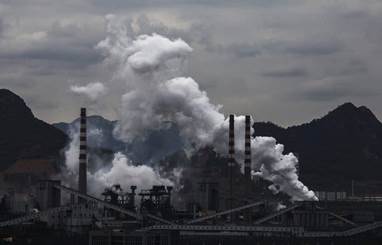
The World Coal Association disputed the conclusion that stopping global warming calls for an end of coal use. Credit...Kevin Frayer/Getty Images
Americans for Prosperity, the political advocacy group funded by the libertarian billionaires Charles and David Koch, has made a point of campaigning against politicians who support a carbon tax.
“Carbon taxes are political poison because they increase gas prices and electric rates,” said Myron Ebell, who heads the energy program at the Competitive Enterprise Institute, an industry-funded Washington research organization, and who led the Trump administration’s transition at the Environmental Protection Agency.
The report details the economic damage expected should governments fail to enact policies to reduce emissions. The United States, it said, could lose roughly 1.2 percent of gross domestic product for every 1.8 degrees of warming.
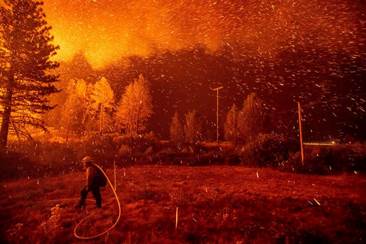
A wildfire in Shasta-Trinity National Forest in California last month. The new I.P.C.C. research found that wildfires are likely to worsen if steps are not taken to tame climate change.Credit...Noah Berger/Associated Press
In addition, it said, the United States along with Bangladesh, China, Egypt, India, Indonesia, Japan, the Philippines and Vietnam are home to 50 million people who will be exposed to the effects of increased coastal flooding by 2040, if 2.7 degrees of warming occur.
At 3.6 degrees of warming, the report predicts a “disproportionately rapid evacuation” of people from the tropics. “In some parts of the world, national borders will become irrelevant,” said Aromar Revi, director of the Indian Institute for Human Settlements and an author of the report. “You can set up a wall to try to contain 10,000 and 20,000 and one million people, but not 10 million.”
The report also finds that, in the likelihood that governments fail to avert 2.7 degrees of warming, another scenario is possible: The world could overshoot that target, heat up by more than 3.6 degrees, and then through a combination of lowering emissions and deploying carbon capture technology, bring the temperature back down below the 2.7-degree threshold.
In that scenario, some damage would be irreversible, the report found. All coral reefs would die. However, the sea ice that would disappear in the hotter scenario would return once temperatures had cooled off.
“For governments, the idea of overshooting the target but then coming back to it is attractive because then they don’t have to make such rapid changes,” Dr. Shindell said. “But it has a lot of disadvantages.”
For more news on climate and the environment, follow @NYTClimate on Twitter.